

THREADS
One Record. Both Parties. No Disputes.
When you and your partner commit to the same quote, order, or invoice—at the same moment—there's nothing to reconcile later. Threads makes shared commitment the default.
THE PROBLEM
Telecom Settlement Is Broken by Design
You and your partner both have records. They're both "correct." And they never match.
80-85%
of telecom invoices contain discrepancies
Source: Wipro Industry Analysis
$30-135B
annual settlement losses industry-wide
Source: PwC, Infosys
2.3 years
average time to full inter-carrier reconciliation
Source: Infosys Telecom Report
AVAILABLE NOW
Telecom Threads You Can Run Today
Pre-built threads for common telecom workflows. Mplify-aligned and compatible. Live in weeks.
Rated Quotes
Quote errors cascade into order mismatches, billing disputes, and write-offs. Lock terms the moment both parties agree.
LSO Sonata Quoting API
Rated Orders
Manual order entry introduces errors that compound downstream. Orders convert directly from committed quotes—no re-keying, no interpretation gaps.
LSO Sonata Ordering API
Billing & Settlement
Month-end means weeks matching records across dozens of partners. Billable events commit as they occur—invoices generate, not negotiate.
LSO Sonata Billing API
SLA Assurance
Each party has different outage timestamps. Both commit to availability events together—credits calculate automatically.
LSO Sonata Trouble Ticketing API
CIM
Maintenance windows get missed. Incident updates arrive late. Coordinate schedules with shared, committed notification state.
LSO Performance Monitoring API
HOW IT WORKS
Both Parties Commit. State Locks.
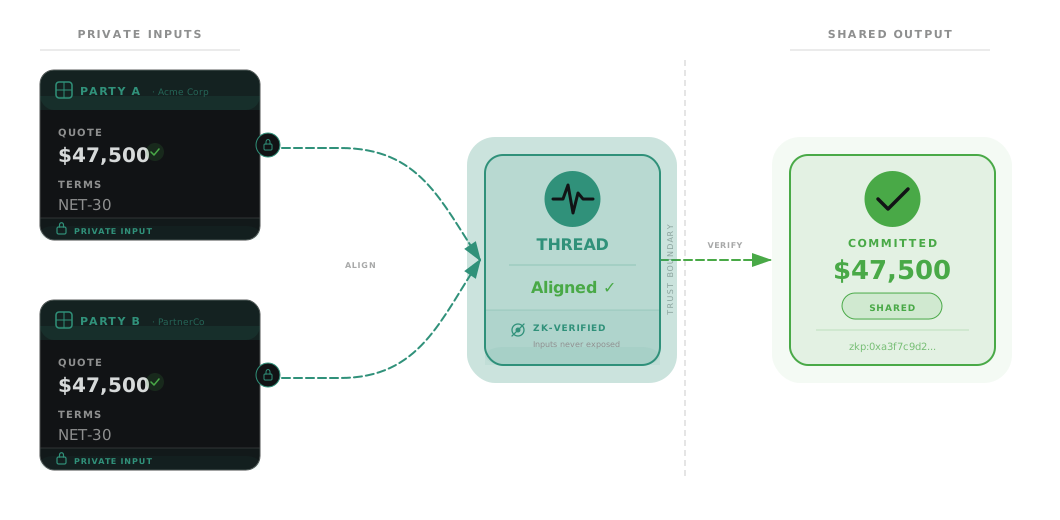
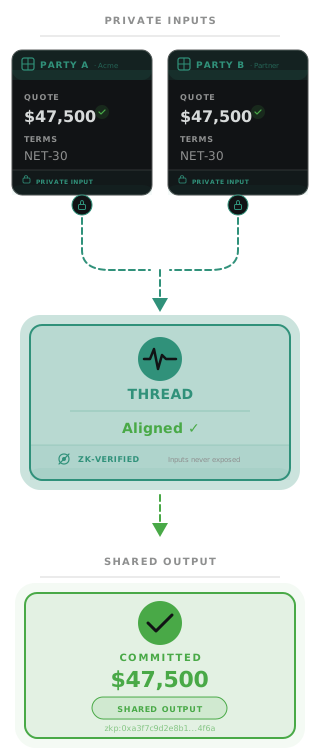
Threads don't sync data between systems. They create a single shared record that both parties commit to—before the next workflow step happens.
1
Both Parties Submit Terms
You submit your understanding of the quote, order, or event. Your partner submits theirs. Submissions are private until both are received.
2
Thread Verifies Alignment
The thread compares submissions. Do the prices match? Quantities? Terms? If yes, proceed. If not, both parties are notified of the specific discrepancy.
3
State Locks
When terms align, state locks. This isn't your copy or their copy—it's the shared committed record. Neither party can unilaterally change it.
4
Systems Update
Both parties receive the committed state via webhook or API. Your systems update. Their systems update. From the same source. With cryptographic proof.
Ready to eliminate reconciliation?
Get the technical deep-dive or talk to our team.
IN PRACTICE
From Weeks to Minutes
End of month: 47 partners. $2.1M in orders. How long before the numbers match?
89% → 0
variance rate
disputes eliminated at source
$684k
saved annually
2 FTE + write-offs recovered
100%
audit-ready
cryptogrpahic proof of agreement
INTEGRATION
How Threads Plug Into Your Stack
Your data stays in your systems—only commitments flow through the thread.
Connect
REST APIs, webhooks, or SDK (Python, Node, Go). Map your data to thread schemas—we provide Mplify-aligned templates for telecom.
Govern
Enterprise wallet (HSM-backed). Role-based permissions. Per-thread access policies. Optional SeamLock integration.
Operate
Committed states flow back via webhooks or API polling. Your OSS/BSS updates automatically. No manual data entry.
IMPLEMENTATION
Live with One Partner in 3 Weeks
1
Configure
Select thread type. Map your data. Connect via API. Test in sandbox.
2
Onboard Partner
Partner maps their data. Joint testing. Edge case validation.
3
Go Live
Production with single partner. Validate committed states. Baseline for rollout.
What you need:
□ Billing/ordering system with API or file export
□ IT resource for integration (16-24 hours)
□ One willing partner who shares the reconciliation pain
FUTURE
Threads are Modular
We started with telecom because the pain is quantified. But shared commitment works anywhere two parties need to agree—supply chain, logistics, financial services.
If you can define the data and the process, we can thread it.
FAQs
Frequently asked
How do Threads integrate with our OSS/BSS or ERP?
Threads connect via REST APIs, SDKs, and webhooks. Your systems submit inputs, receive verified outcomes, and trigger downstream workflows. No blockchain expertise required—we handle the cryptographic infrastructure.
What happens if parties submit conflicting data?
Threads detect discrepancies and return a verification failure. The workflow pauses until both parties align their inputs. This happens in seconds, not days—and the exact point of conflict is identified automatically.
Do we need blockchain expertise?
No. Threads abstract the cryptographic complexity. Your teams work with familiar REST endpoints and SDKs. Proofs anchor to L1 for independent verification, but you never touch chain infrastructure directly.
How does ZK privacy work in Threads?
Zero-knowledge proofs verify that an outcome was computed correctly without revealing the underlying inputs. Partners see proof that thresholds were met, rules were followed, and calculations are correct—without seeing the raw numbers.
Can we run multiple Threads in parallel?
Yes. Threads are designed to run concurrently across partners. You can run Rated Quotes with Partner A while running Billing with Partner B. Each Thread maintains its own state and verification.
What compliance certifications apply?
Interweave maintains SOC 2 Type II certification. Smart contracts are audited by third-party security firms. All outcomes are cryptographically signed and independently verifiable. Telecom Threads are Mplify/MEF-aligned.
THE INTERWEAVE FABRIC
Start with Trust. Add Alignment. Enable Settlement.
SeamLock establishes agent identity. Threads aligns what both parties agree to. Shuttle settles payment when work completes.
Start with Telecom Threads
Mplify-aligned. API-first. In production across partner networks.